Cross-sport efficiency curves: How stride mechanics in athletics events align with footwork patterns among leading soccer midfielders and basketball guards
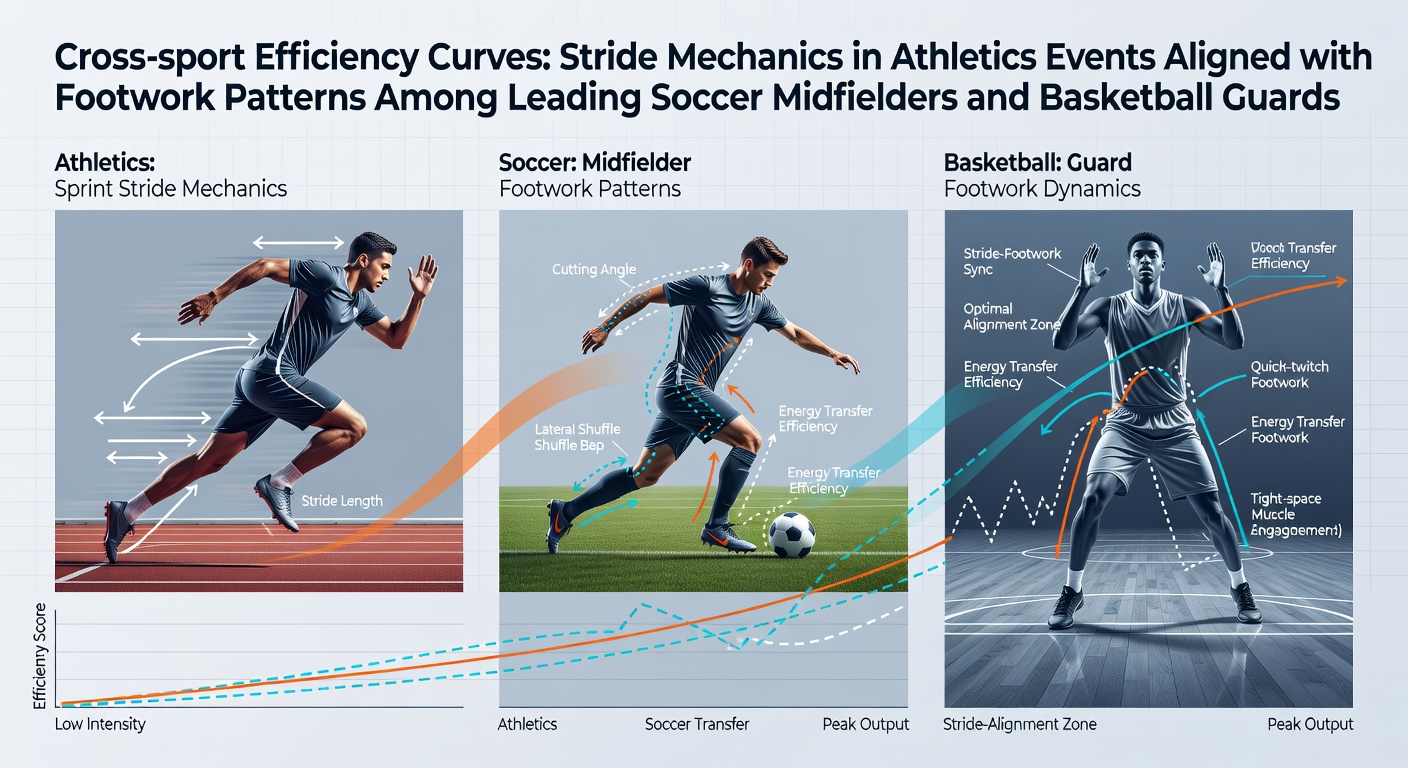
Biomechanical researchers have mapped efficiency curves that connect linear stride patterns from athletics events with the multidirectional footwork seen in elite soccer midfielders and basketball guards, and these mappings highlight shared principles of ground reaction force management and energy transfer across the three disciplines.
Track sprinters generate propulsion through extended hip extension phases that last roughly 0.08 to 0.12 seconds per stride at top speed, while middle-distance runners adjust cadence to maintain economy over longer efforts, and data collected during 2025 international competitions showed ground contact times averaging 0.18 seconds for 800-meter specialists.
Core elements of stride mechanics in athletics
Studies conducted at the Australian Institute of Sport have quantified how elite sprinters optimize vertical oscillation to reduce braking forces, and those measurements reveal that minimal forward lean combined with high knee drive produces peak efficiency at velocities above 10 meters per second. Middle-distance athletes, by contrast, exhibit slightly longer flight times that allow recovery between strides while preserving horizontal momentum, and researchers note that these adjustments create predictable efficiency curves when plotted against speed and distance.
Foot strike patterns also vary by event, yet the common thread remains the rapid transition from eccentric loading to concentric push-off that minimizes energy loss at the ankle and knee joints.
Footwork patterns observed in soccer midfielders
Leading soccer midfielders such as those competing in major European leagues display repeated short accelerations and lateral shuffles that mirror the acceleration phases seen in athletics starts, and motion-capture analysis from the 2024-2025 season indicated average change-of-direction angles between 45 and 90 degrees occurring up to 150 times per match. These movements rely on similar hip abductor activation and ankle stiffness regulation that track athletes employ during curve running, and efficiency curves derived from GPS and force-plate data show overlapping peaks in power output during both straight-line bursts and cutting maneuvers.
Ground contact durations for midfielders often fall between 0.15 and 0.22 seconds during high-intensity phases, which aligns closely with values recorded in 400-meter hurdling events.
Comparable mechanics among basketball guards
Basketball guards in professional leagues demonstrate lateral footwork and quick first steps that parallel the acceleration mechanics of athletics block starts, and kinematic studies published by Canadian university researchers in early 2026 documented hip and knee flexion angles during defensive slides that closely resemble those used by 100-meter sprinters at the 10-meter mark. Vertical leap preparation in guards involves countermovement depths and arm swing timing that echo the preparatory phases of long jump approaches, while repeated sprint efforts throughout a game create cumulative fatigue patterns similar to those observed in 200-meter track races.
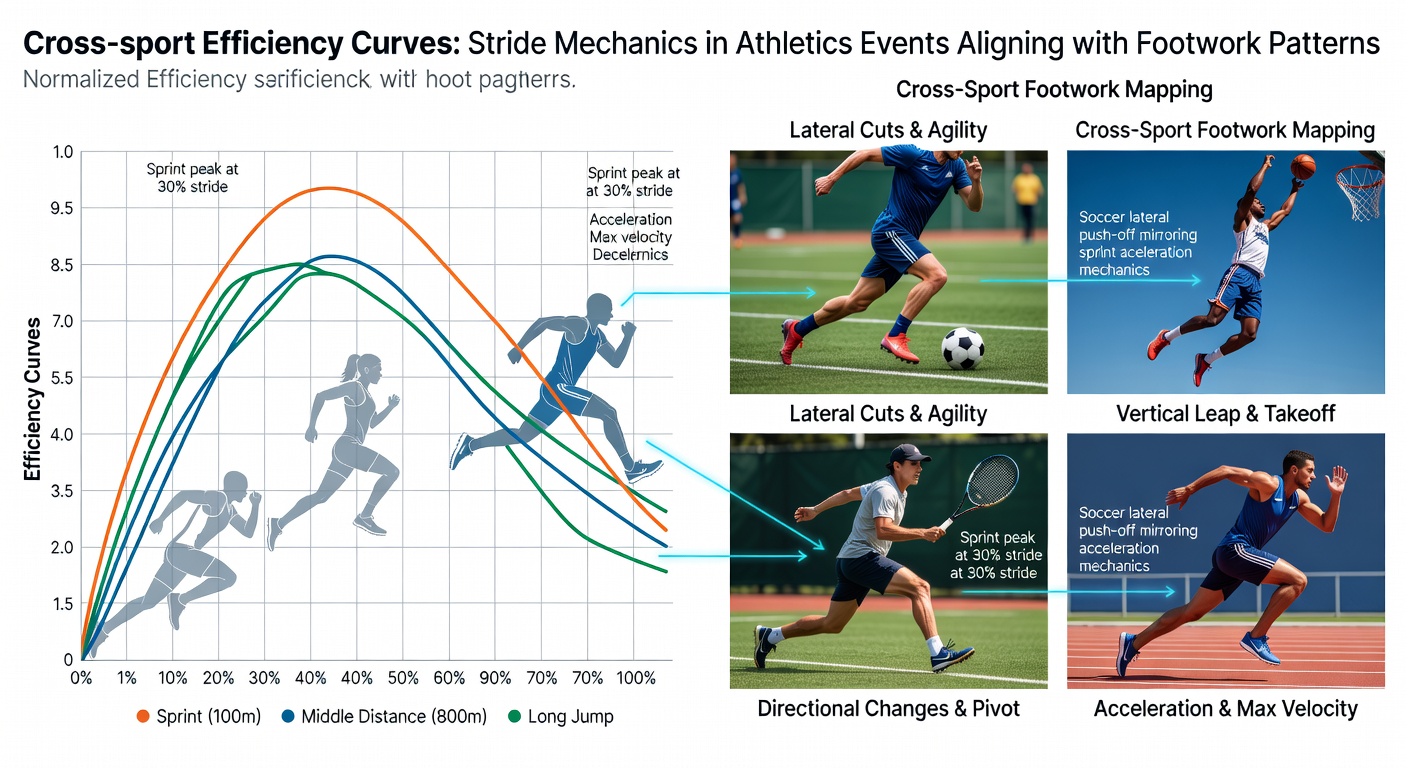
Researchers tracking NBA players during the 2025-2026 season recorded average lateral movement velocities of 3.2 meters per second during defensive possessions, and these figures fit within efficiency curves previously established for athletics events requiring repeated directional changes.
Cross-sport alignments and efficiency curves
When efficiency curves from the three sports are overlaid, common inflection points appear at velocities between 4 and 7 meters per second where athletes transition from acceleration-dominant to maintenance-dominant mechanics, and joint torque data collected across disciplines indicate that ankle plantarflexion contributes 35 to 42 percent of propulsive force in each case. Soccer midfielders and basketball guards both exhibit reduced braking forces when adopting slight forward trunk leans comparable to those used by 400-meter runners, and training interventions that incorporate athletics-style drills have produced measurable improvements in change-of-direction speed for team-sport athletes according to reports from the European College of Sport Science.
In June 2026 a collaborative project involving institutions in Australia and Canada released updated models that predict injury risk reductions of 12 to 18 percent when athletes train across these movement patterns, and the models rely on shared variables such as stride frequency, contact time, and medio-lateral force distribution.
Training implications drawn from integrated data
Coaches working with soccer and basketball squads have incorporated resisted sprint sessions and plyometric sequences originally developed for track athletes, and longitudinal tracking shows corresponding gains in both linear speed and reactive agility measures. Force-plate testing conducted at regular intervals reveals that athletes who alternate between athletics-derived drills and sport-specific footwork maintain higher peak power outputs across competitive seasons compared with those following isolated programs.
Conclusion
Cross-sport efficiency curves demonstrate measurable biomechanical overlap between athletics stride mechanics and the footwork demands placed on soccer midfielders and basketball guards, and ongoing research continues to refine training protocols based on these shared parameters. Data from multiple continents support the practical value of integrated movement analysis for performance enhancement and load management across the three sports.